
Architecture
One page on how Orpheus is put together. The depth is in 02-architecture.md (memory, boot, paging, tasks, power, storage), 03 (drivers), 04 (audio) and 05 (UI).
Three facts decide almost everything:
- 320 KiB of RAM and no execute-in-place. The 8 MiB flash is on SPI and not memory-mapped; all code must be copied to RAM before it runs, and the firmware is several times larger than the RAM.
- A Cortex-M4F at 24–288 MHz (1.0 V core supply up to 144 MHz): decoding takes a noticeable share of real time, so scheduling and clock control are part of the audio design.
- No debugger. Everything is observed over USB and through RAM that survives a reset.
Memory
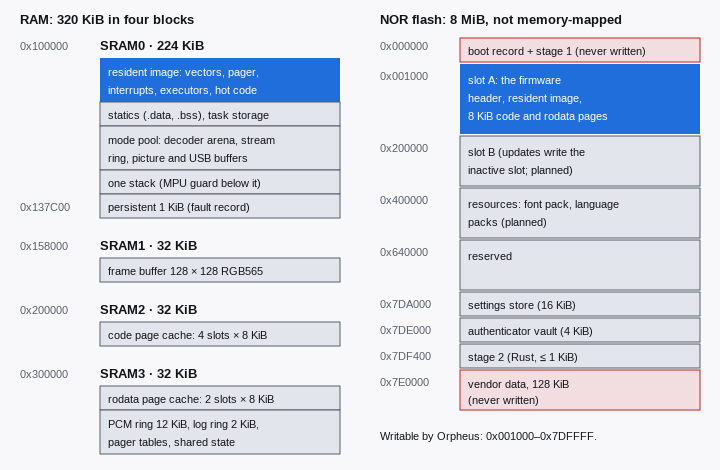
SRAM0 holds the resident image, the statics, one shared mode pool
(re-partitioned for playback, pictures or USB storage) and the single
stack. SRAM1 is exactly the 128 × 128 RGB565 frame buffer, so a screenshot
is a memory read. SRAM2 and SRAM3 are the page caches, plus the PCM ring and
the log ring. Budgets live in budgets.toml and
cargo xtask size --check enforces them.
Boot
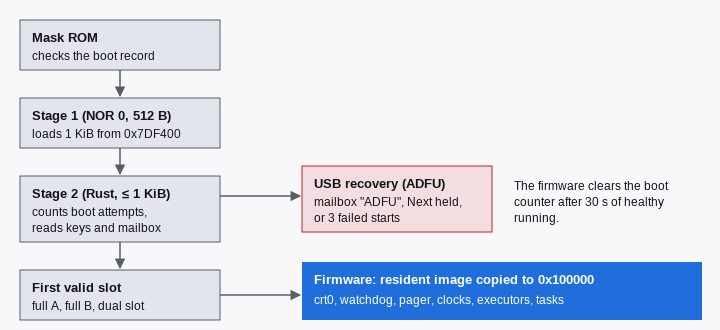
A slot that fails three starts in a row is skipped: stage 2 starts the
next one, after an update also the old, superseded image
(orpheus_proto::boot). The mask ROM's USB recovery mode (ADFU) is always
reachable: by a mailbox word, by holding Next, when every slot failed, and
when the boot record is invalid. That is what makes aggressive development safe. The slot
format ("YFW1": header, resident image, 8 KiB pages) is in
02 §2.3.
Demand paging
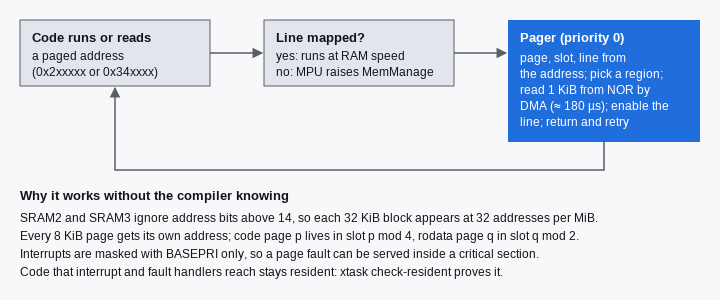
cargo xtask build links the firmware twice: xtask pagelink decides
what is resident (everything reachable from interrupt and fault handlers,
listed by resident.toml and proven by
cargo xtask check-resident) and packs the rest into 8 KiB pages, hot
code first in clusters from hot.toml. The pager itself
(orpheus-pager) has a host-side core with trace tests. A function that
must stay resident while the flash is busy needs #[inline(never)] as well
as a root: the proof cannot see inlined copies.
Executors and tasks
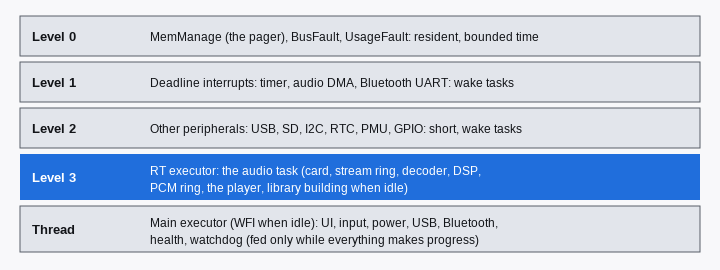
Two Embassy executors share one stack. The RT executor runs at interrupt
level 3 and preempts thread mode, so a long UI operation (sorting a
directory, drawing a list) cannot starve the decoder. Critical sections
mask with BASEPRI, never PRIMASK: a page fault under PRIMASK would be
fatal. Tasks talk through embassy-sync channels and snapshot cells.
Crates
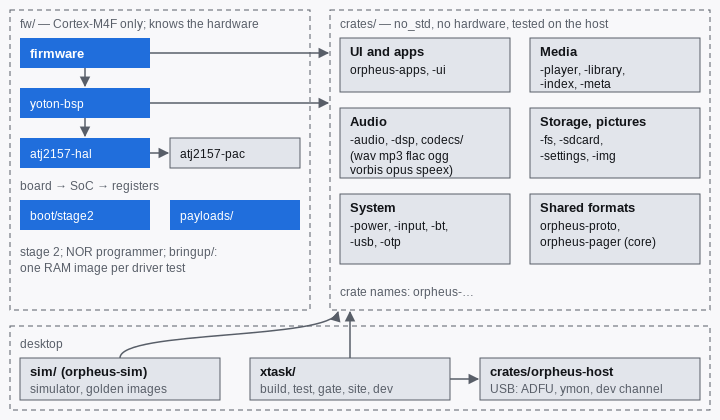
crates/: everything that does not need the hardware: UI toolkit and apps, player and library, file system, codecs, DSP, picture decoders, Bluetooth and USB protocol logic, settings store, power policy. Allno_std, noalloc, tested on the host first.fw/: the second workspace, forthumbv7em-none-eabihf:atj2157-pac(registers),atj2157-hal(drivers and Embassy glue),yoton-bsp(this board),firmware(task wiring and the service implementations), the boot stage, payloads and bring-up images. Only these andorpheus-pagermay useunsafe.- Desktop:
sim/runs the real apps over simulated services (golden images, key scripts);xtask/andorpheus-hostbuild, test and talk to the player over USB.
The apps see the system only through the service traits in
orpheus-apps (services.rs); the simulator and the firmware each
implement them. That seam is what lets the same screens run on the
desktop, on the player and, later, in the browser.
Where to go next
- Getting started
- How-to guides
- STATUS.md: what is built and measured